A four-story brick building on North Wieland Street, custom stainless steel screens on every downspout opening, and one day of rope work instead of a week of scaffolding.
The owner's complaint was specific: pigeons were nesting inside the downspouts, and the sound was coming through the wall of the top-floor unit. The birds had also worked their way in under the fourth-floor deck. This is a common pattern in Old Town — a well-kept brick building where the only unmaintained square footage is the part nobody can reach.
Every downspout on the building starts at an open conductor head: the sheet-metal box at the top of the run that catches water off the gutter and funnels it down. To a pigeon, that box is close to perfect. High walls, a solid floor, a roof over it, and forty feet of air between the nest and anything on the ground. Left alone through a season, it fills with nesting material until the downspout stops draining and the overflow starts running down the brick instead.
Removing the nests solves nothing on its own. The birds come back to the same opening within days. The only durable fix is to close the opening to birds while leaving it fully open to water.
The openings were forty-plus feet up, spread across two elevations of the building. Old Town sits on narrow Near North Side lots: gangways that fit a person and not much else, an alley with no staging room, mature trees against the wall, and neighbors close on both sides. A boom lift has nowhere to set up and nothing to reach over. Scaffolding for a handful of screens would have cost several times the repair, taken a week, and needed permits and sidewalk protection.
Rope access needs a roof and an anchor point instead of a parking spot. Our team rigged from the roof deck, worked down the face of the building, and reached each conductor head directly — no equipment on the ground, no disruption to the neighbors, done in a day.
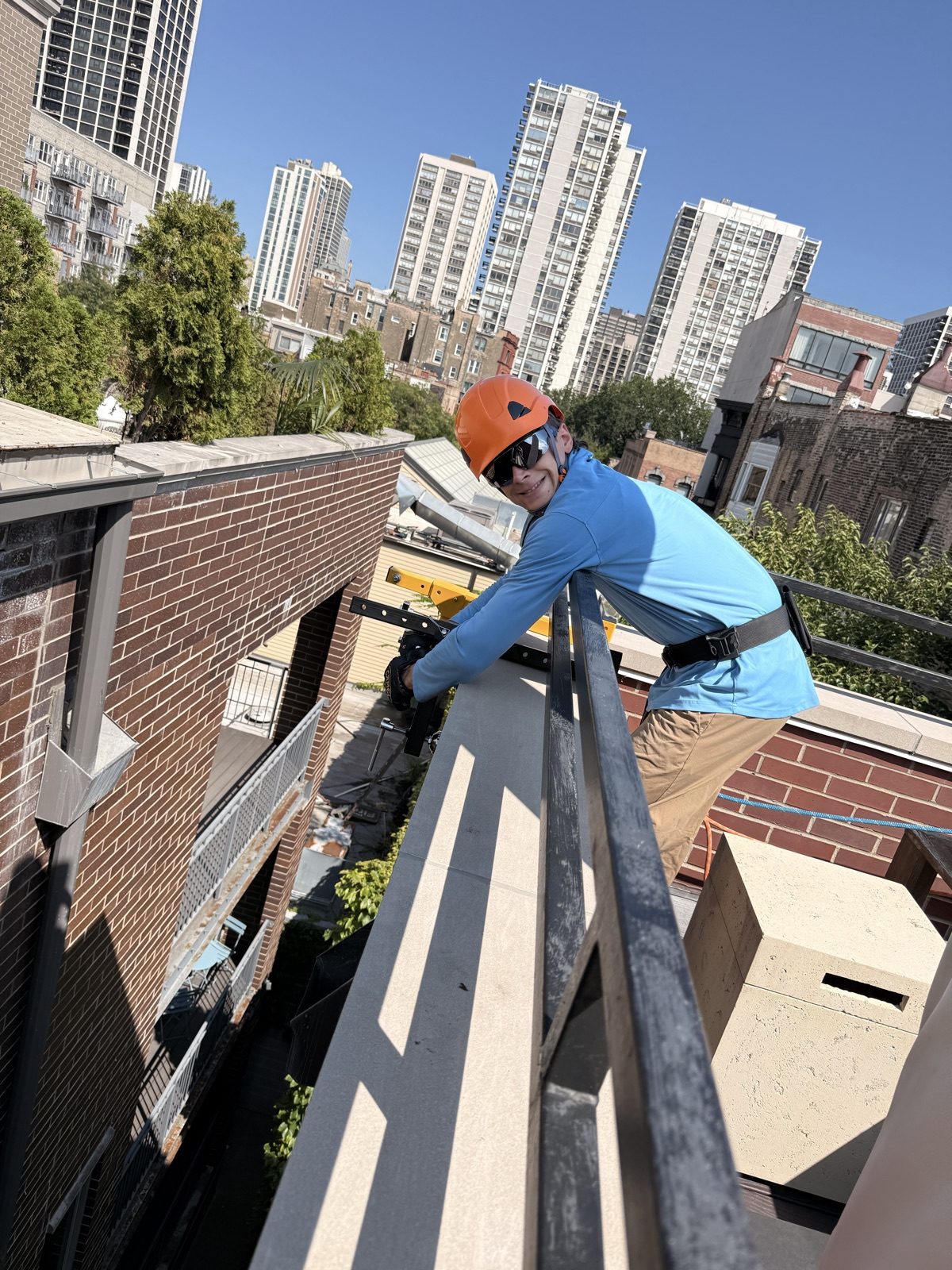
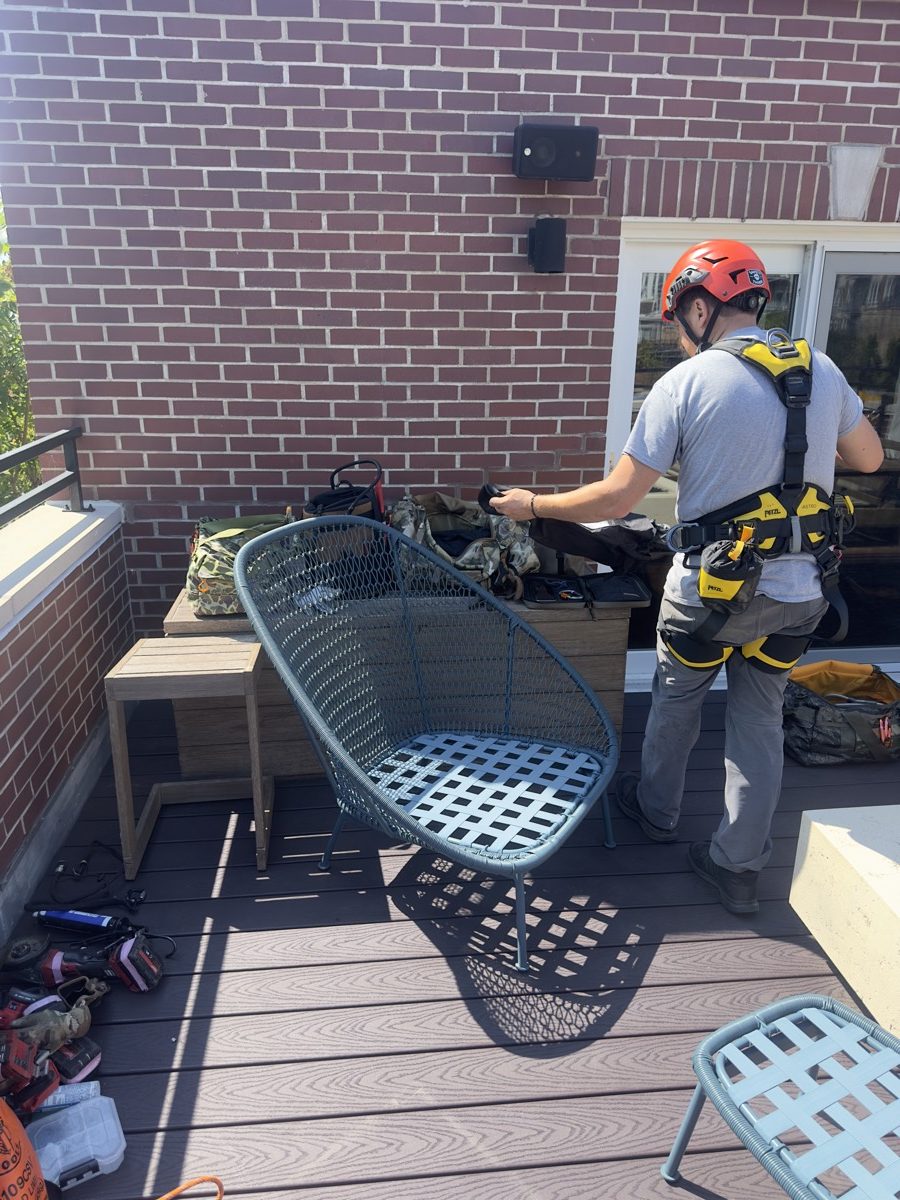
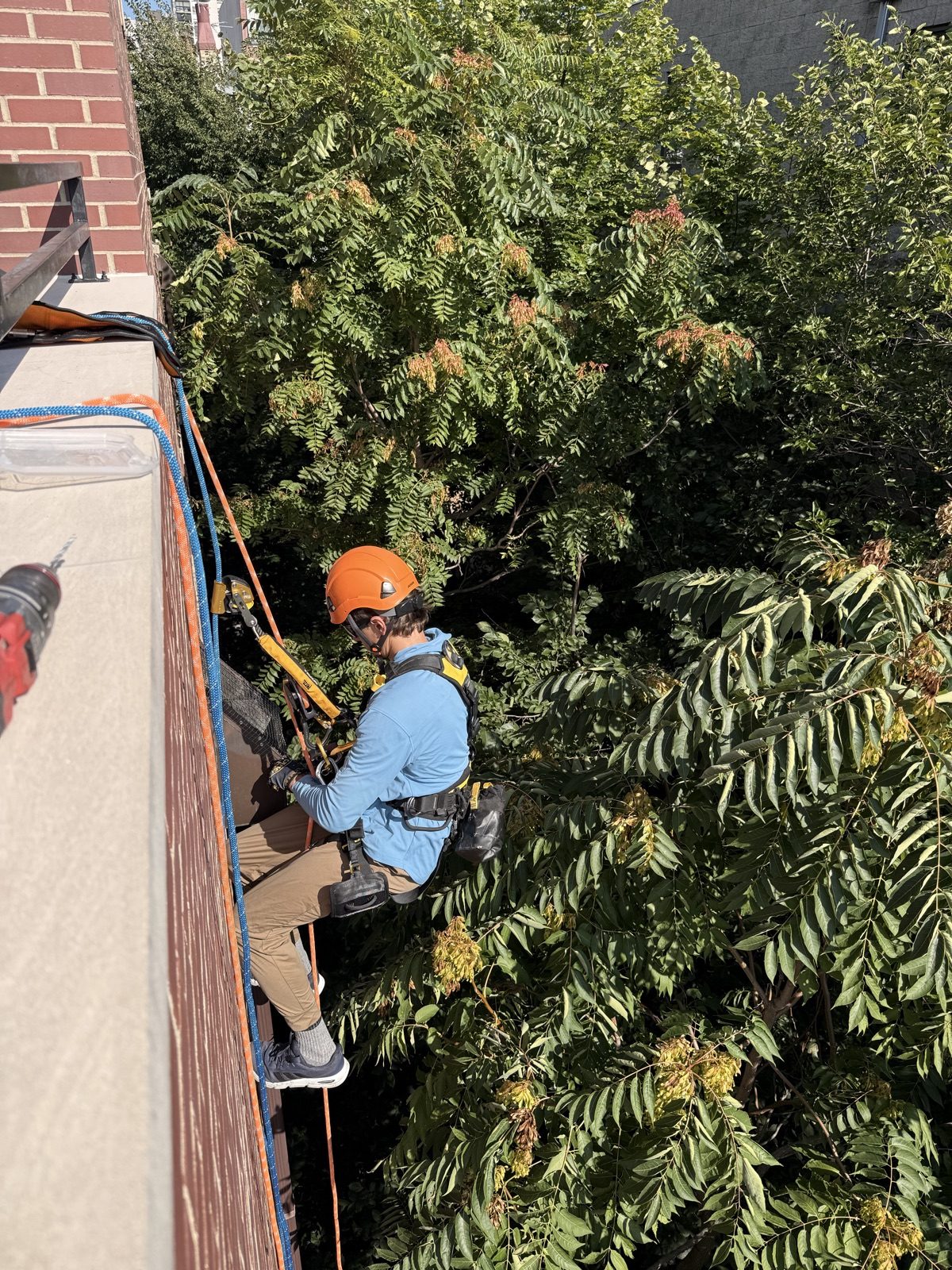
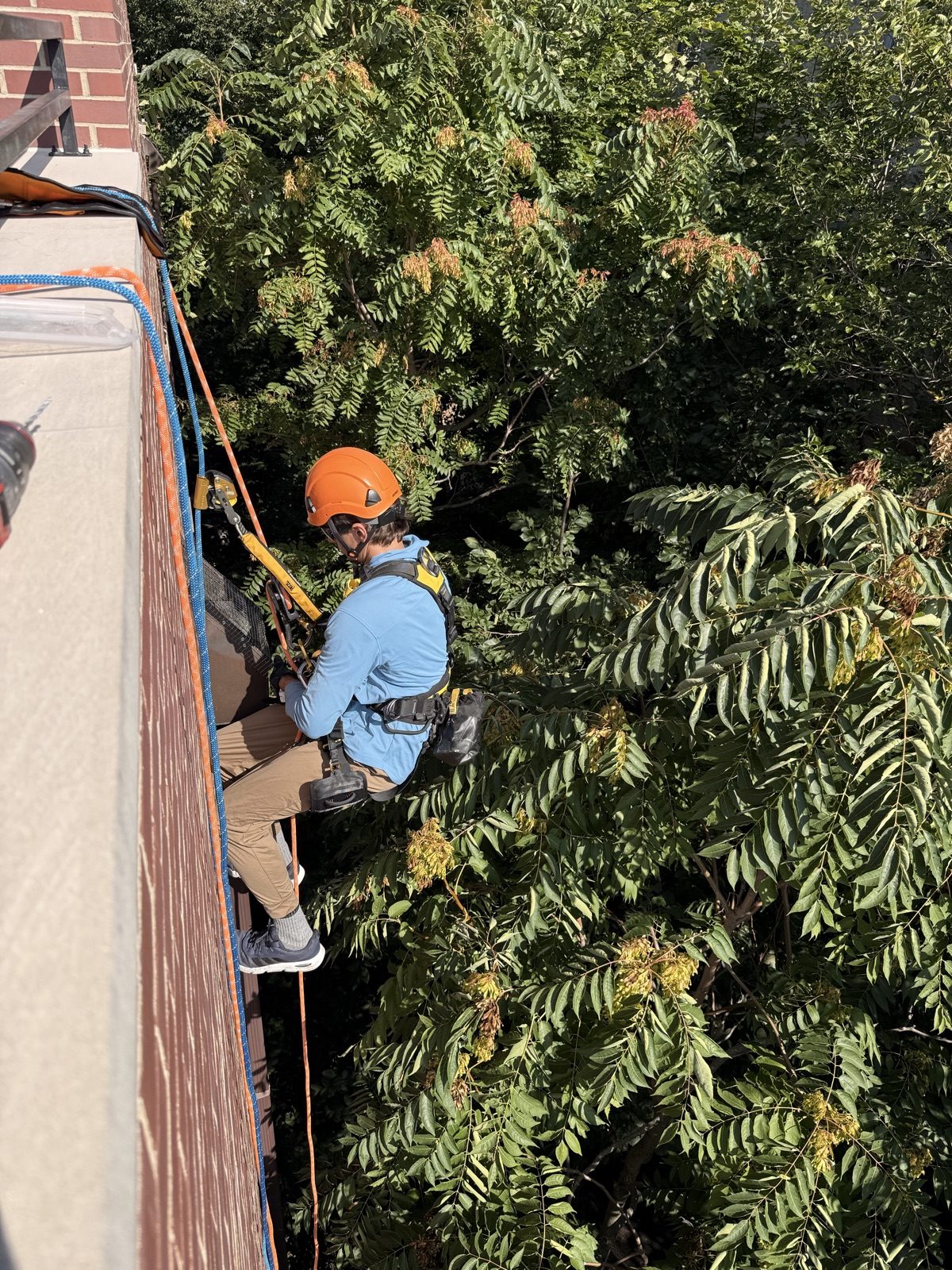
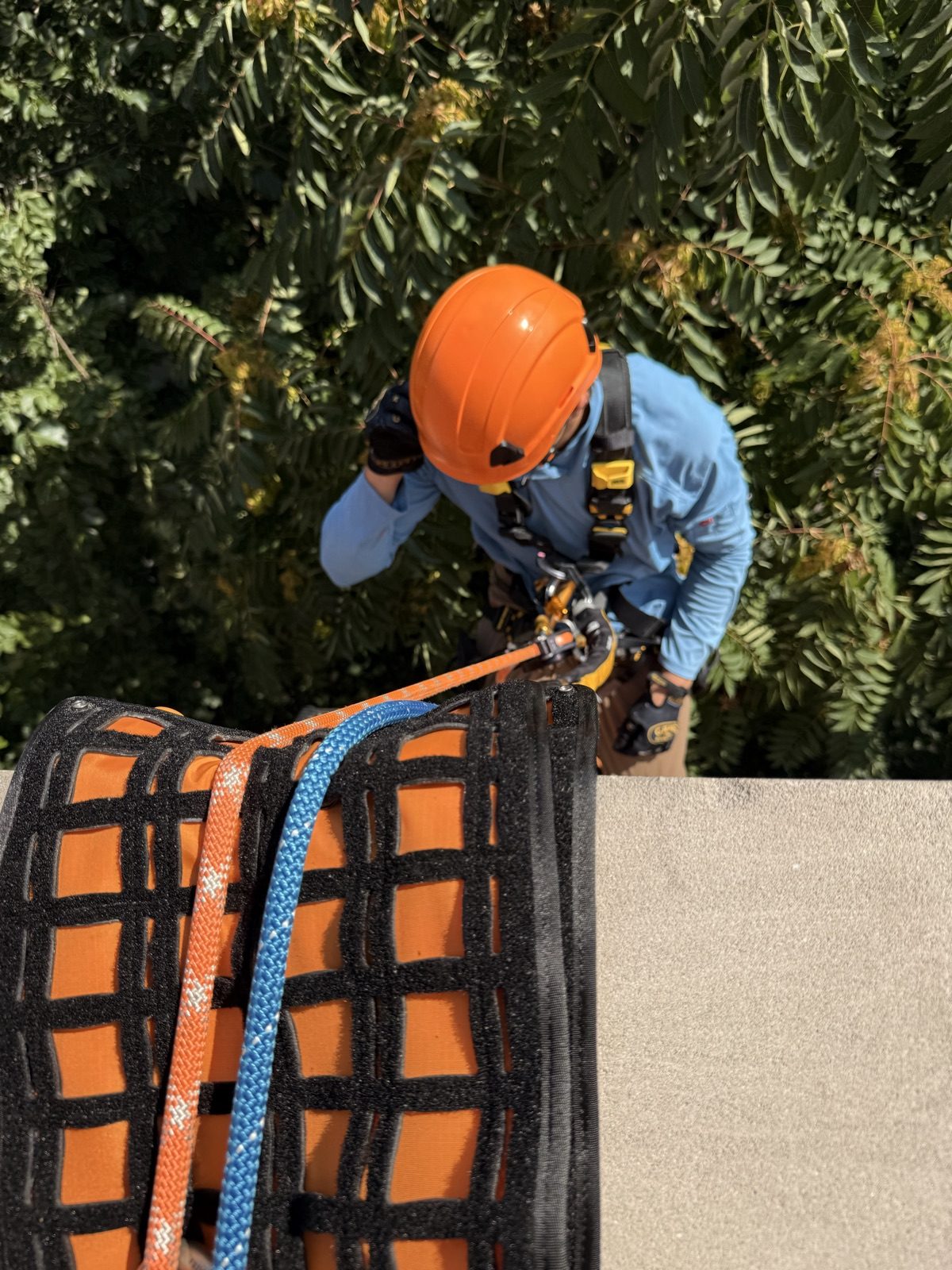
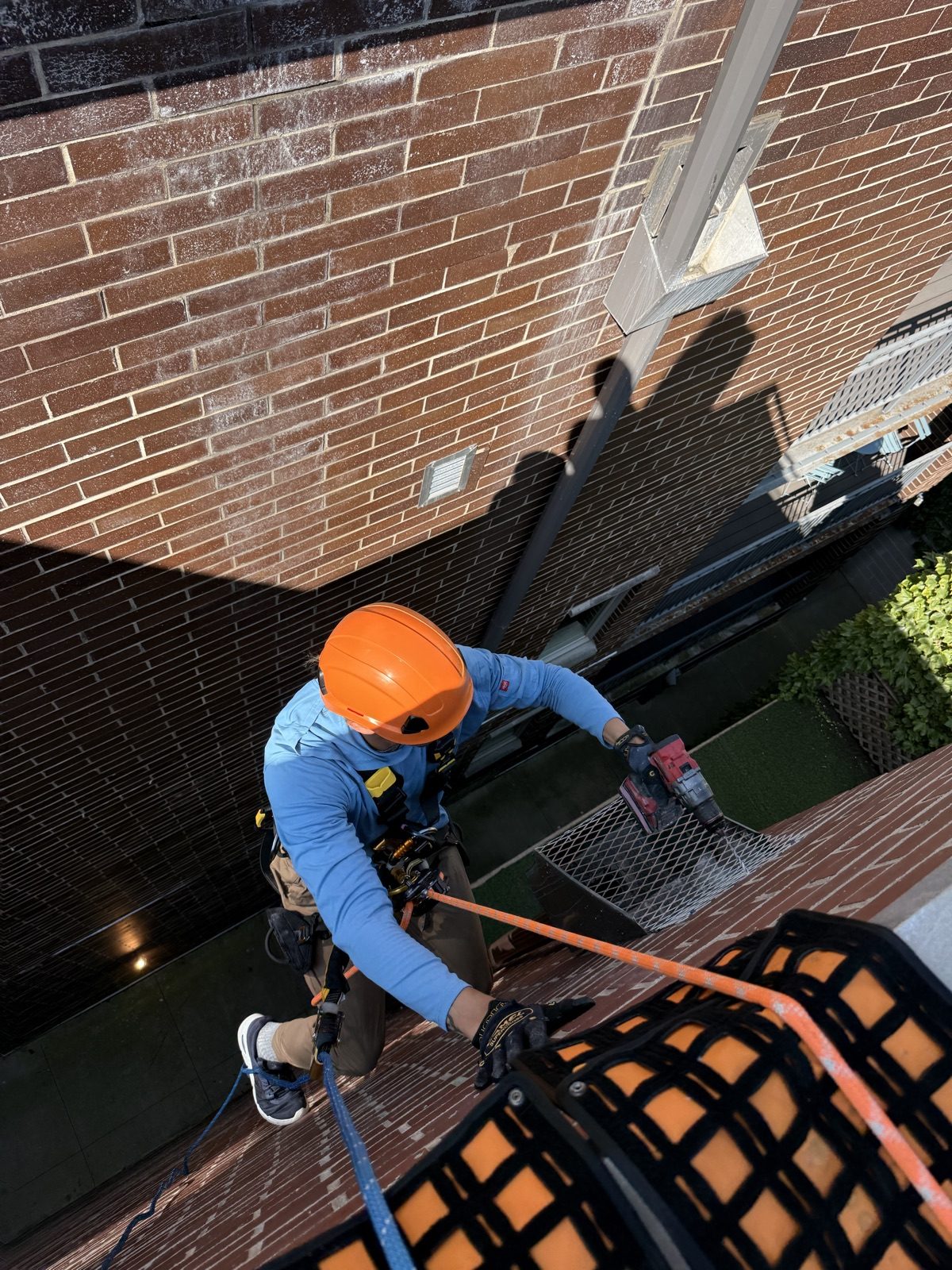
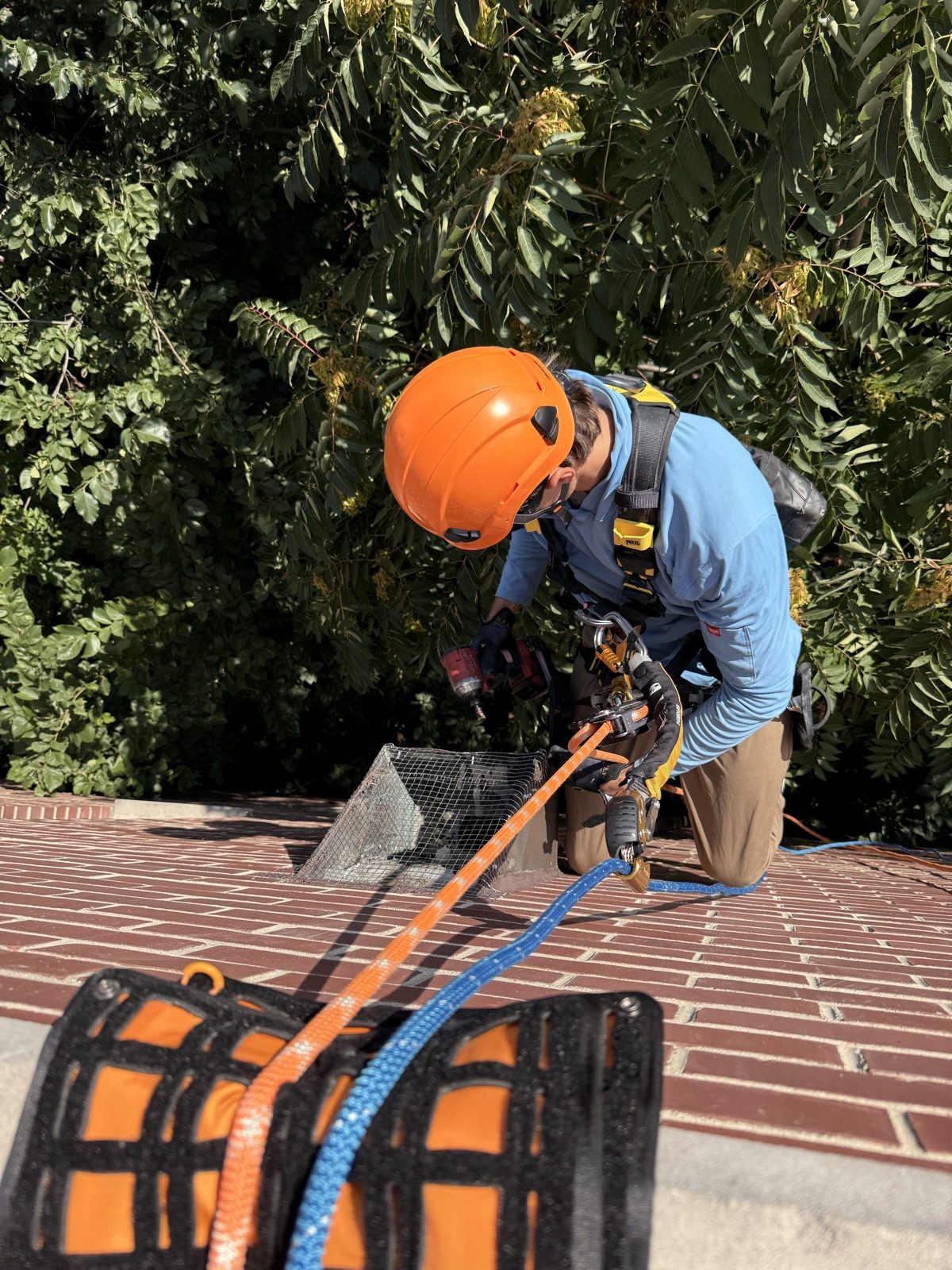
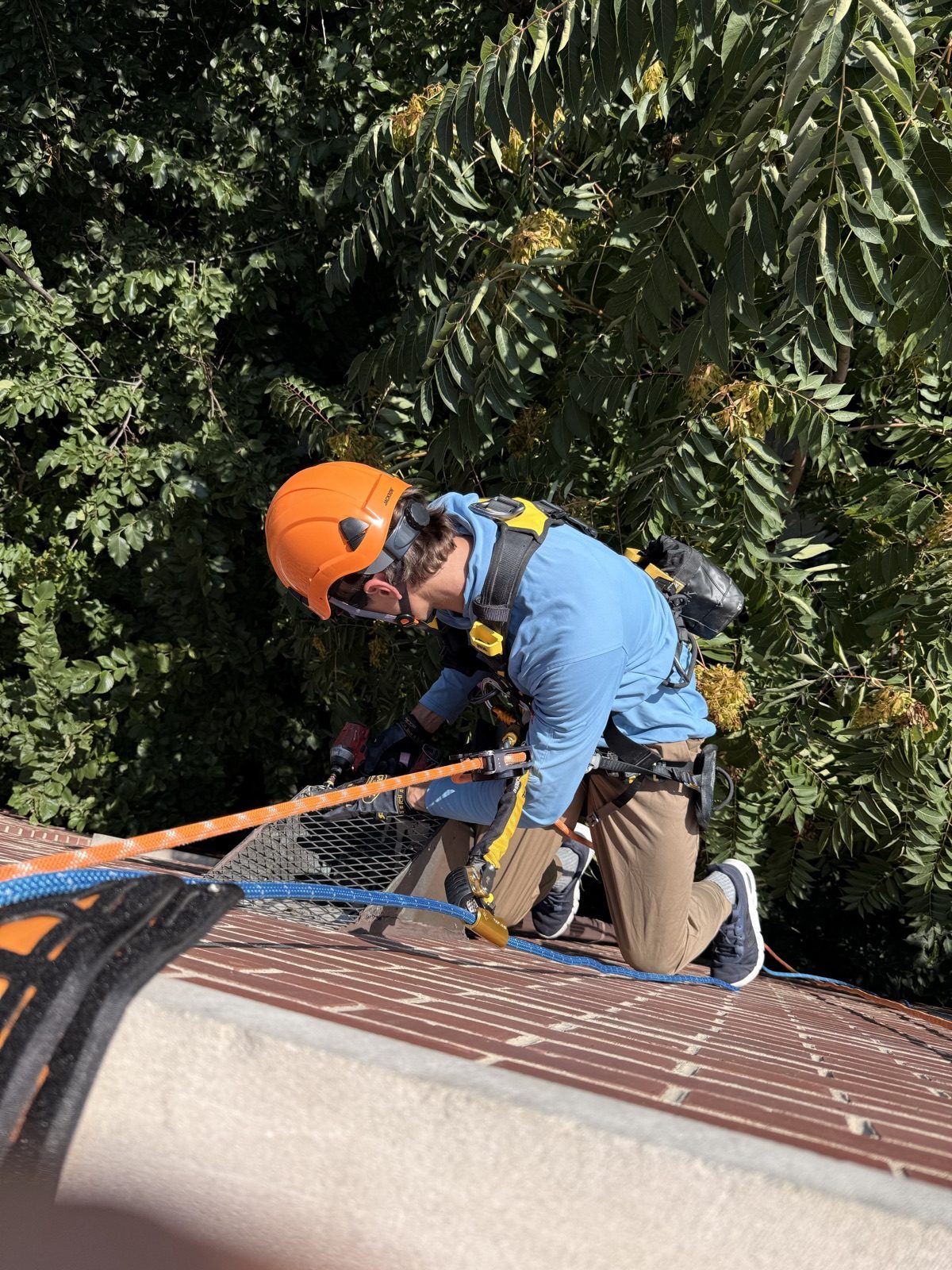
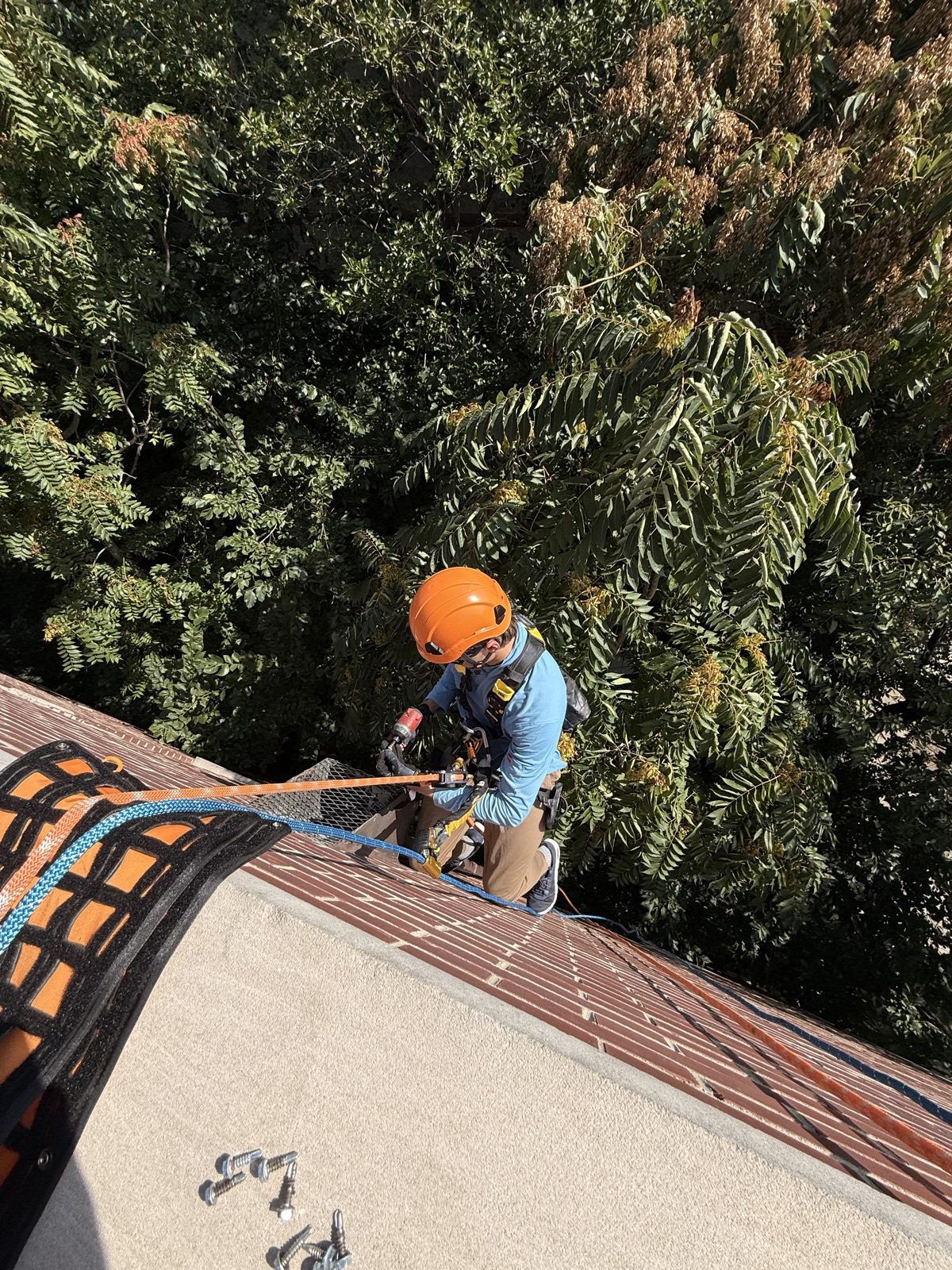
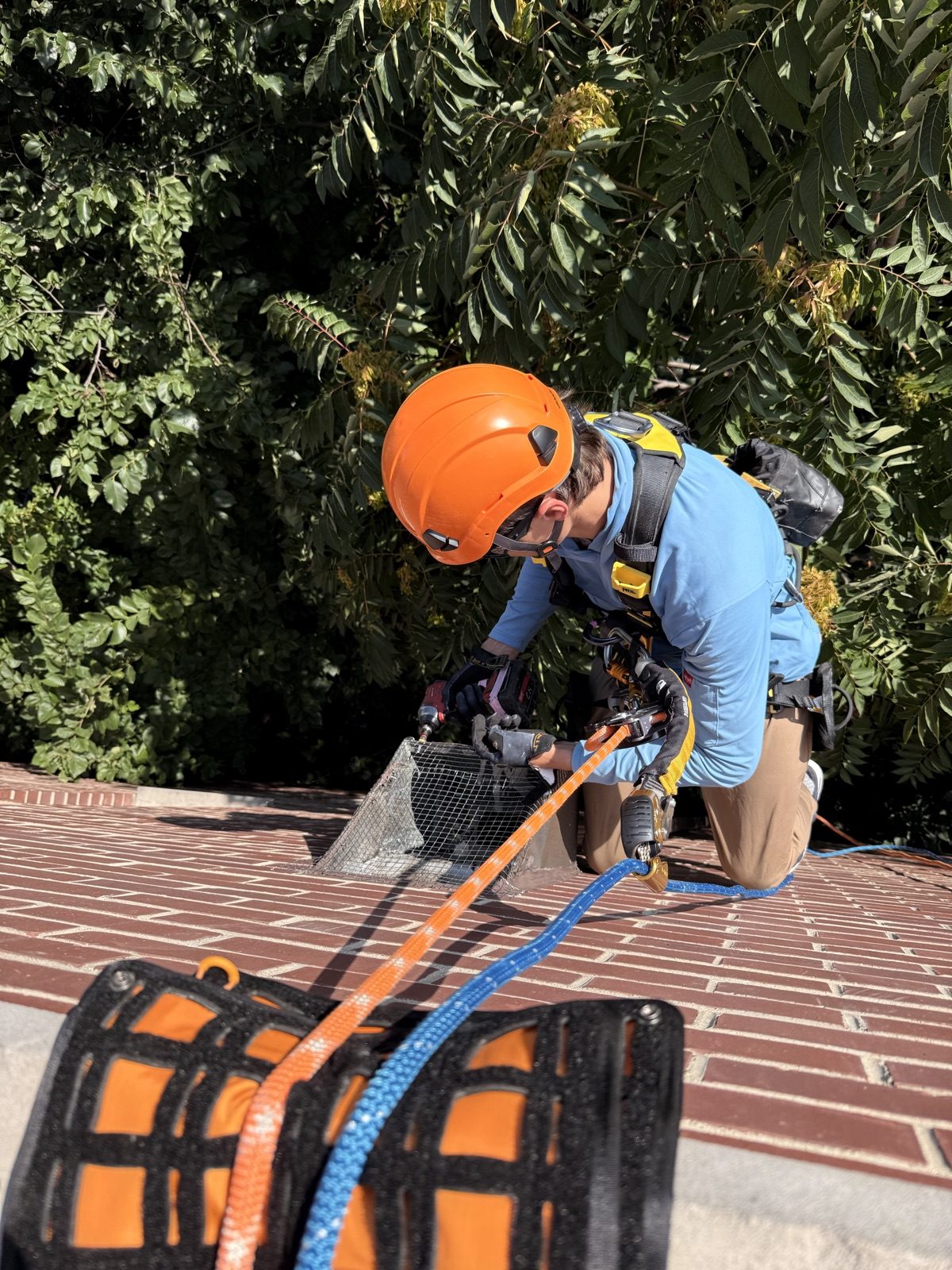
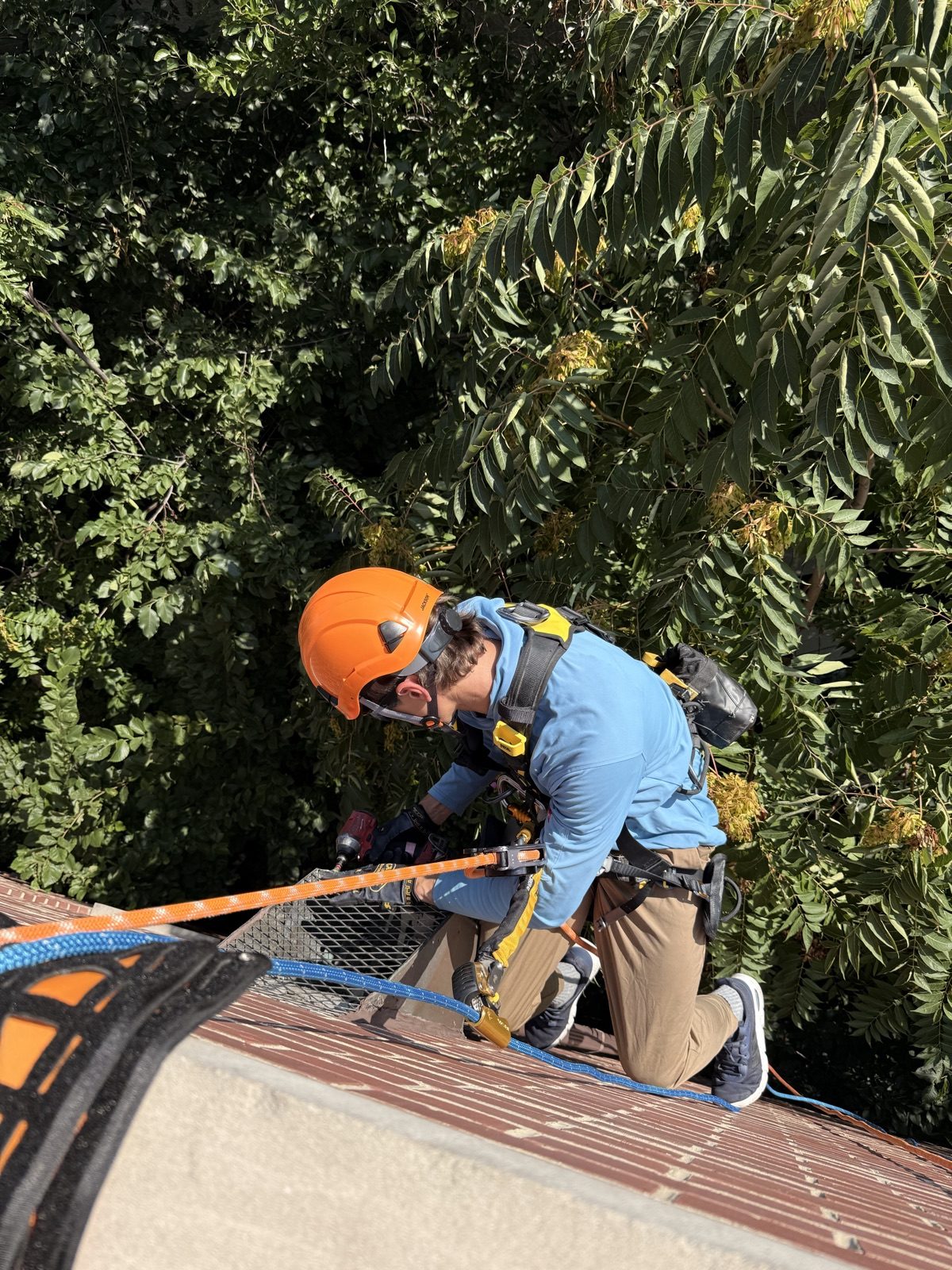
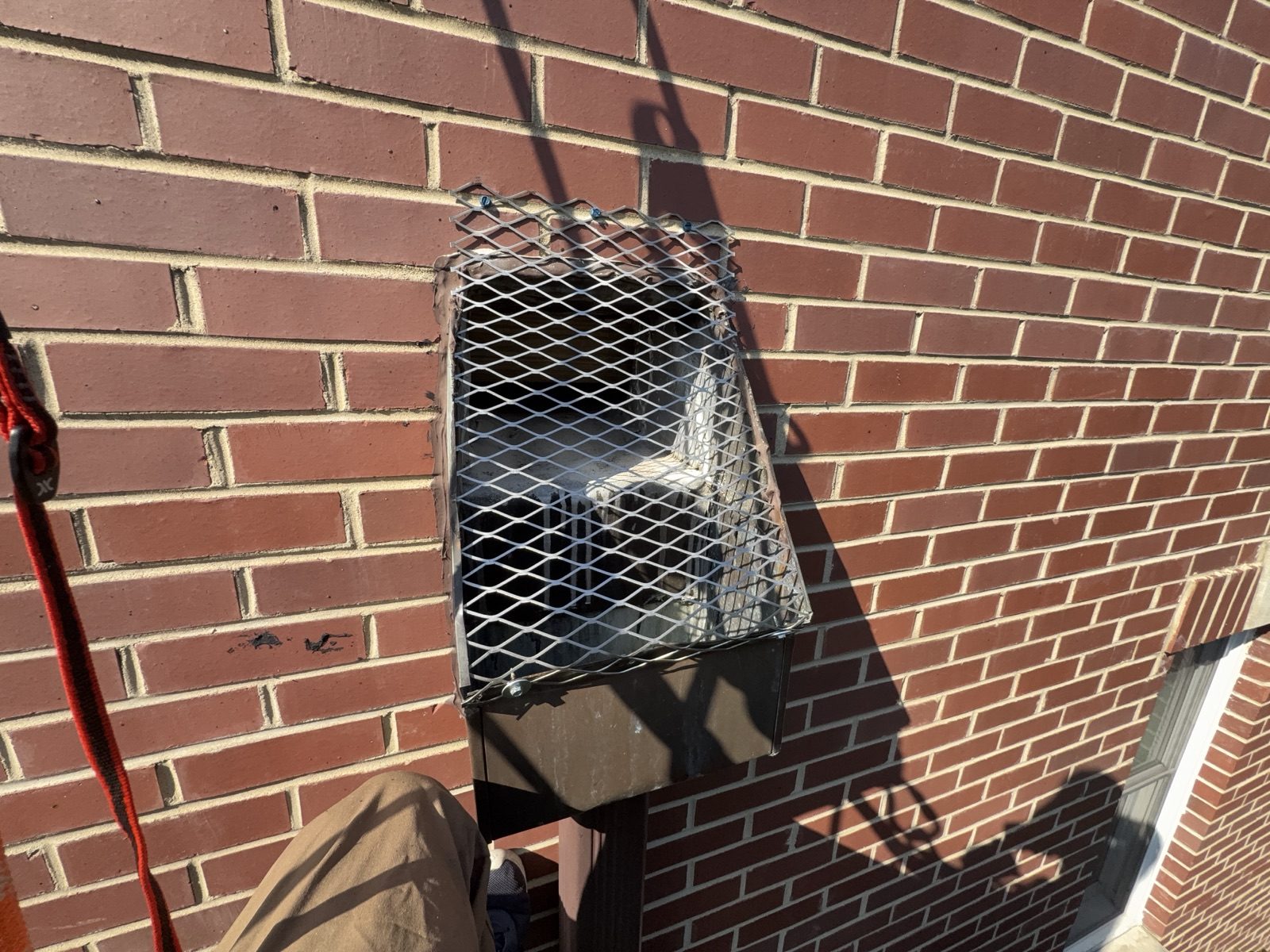
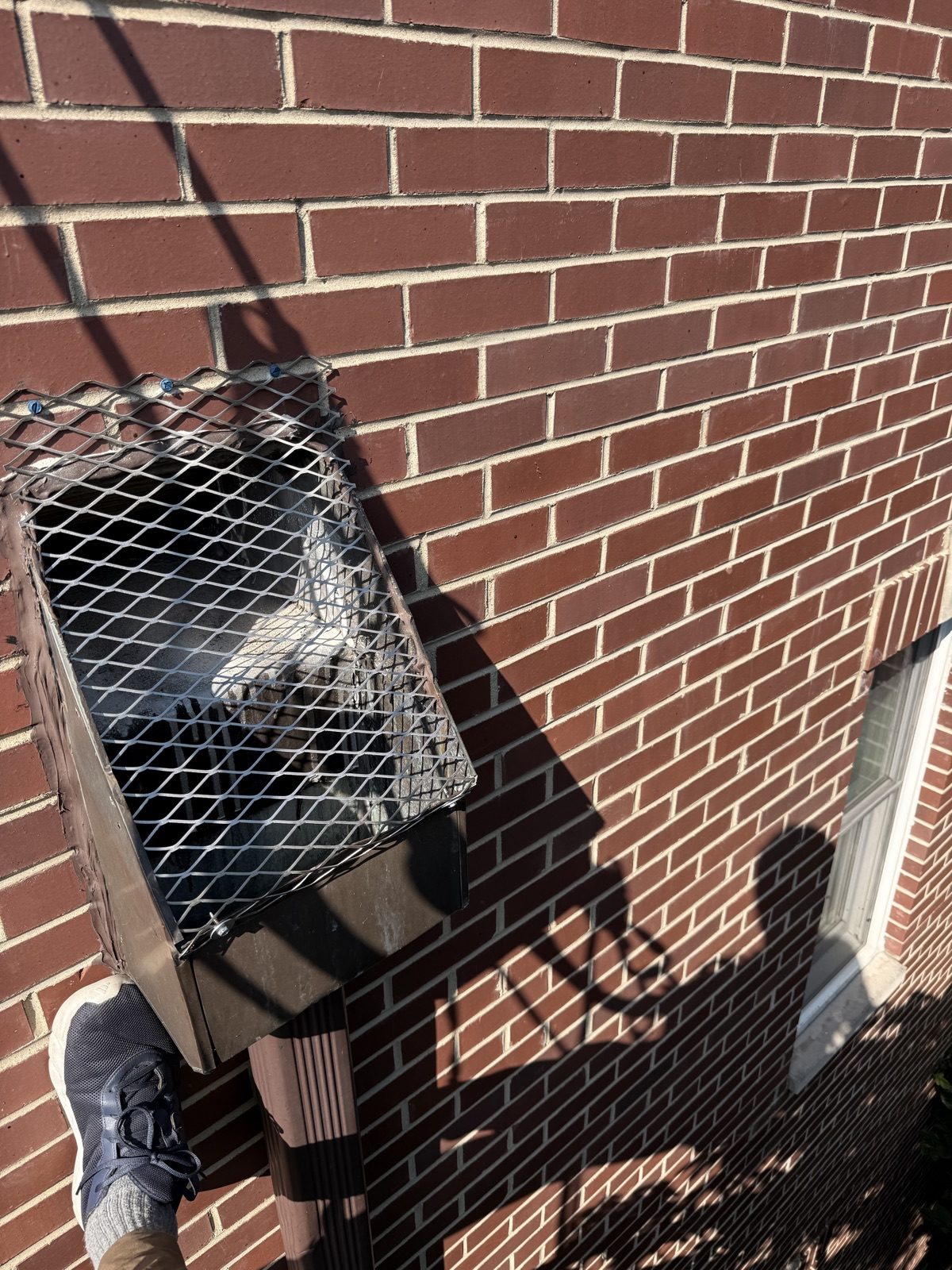
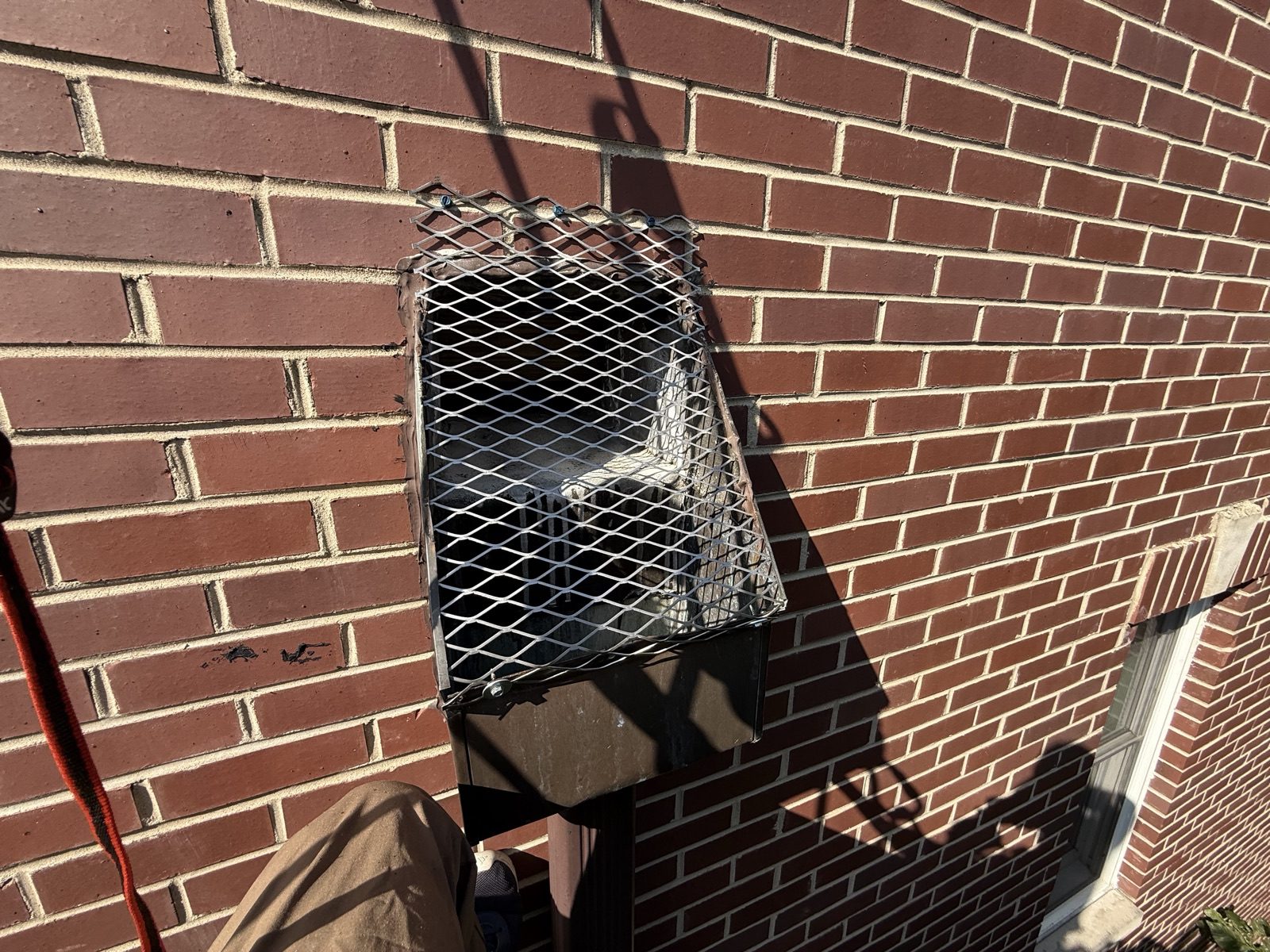
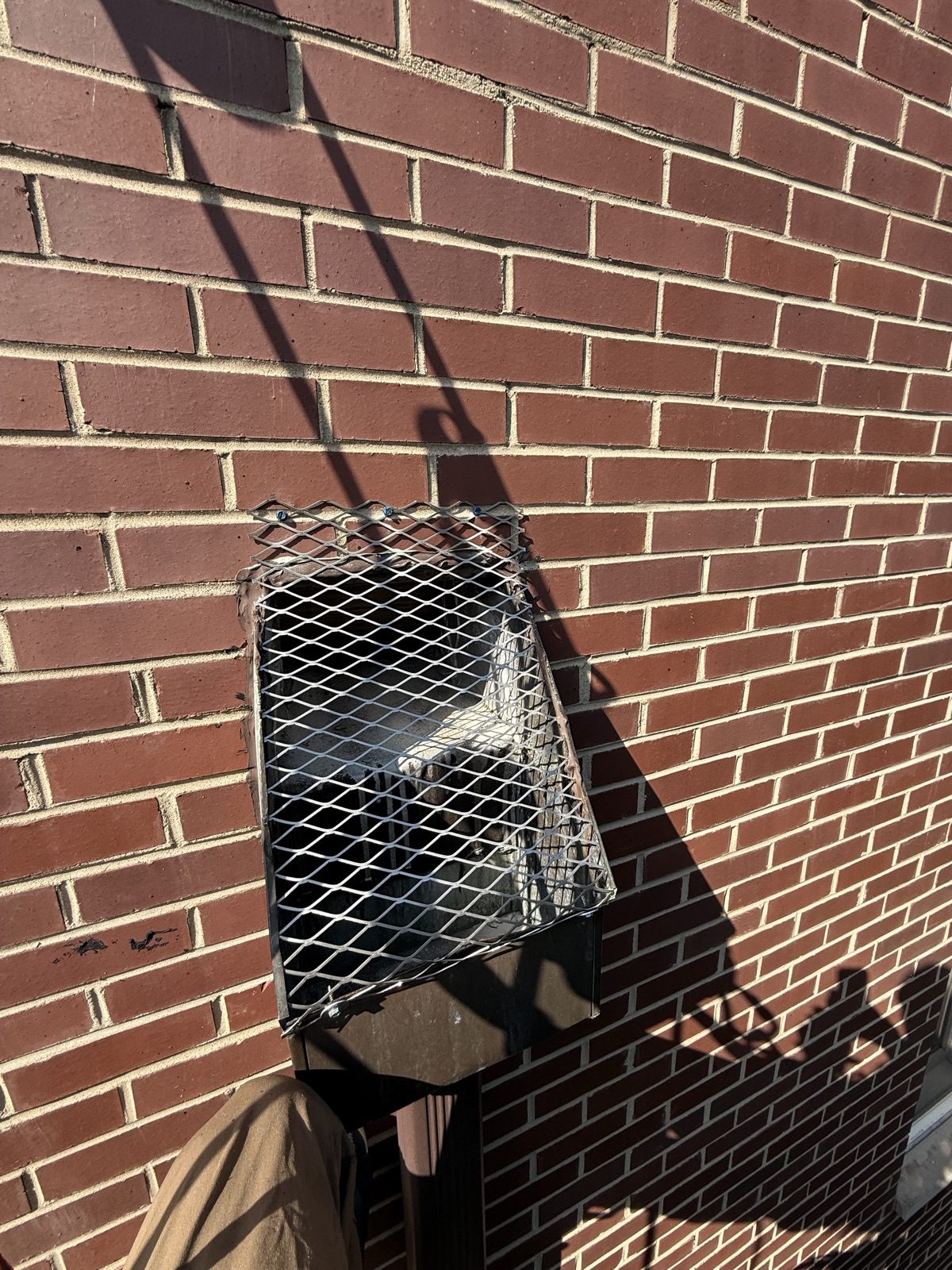
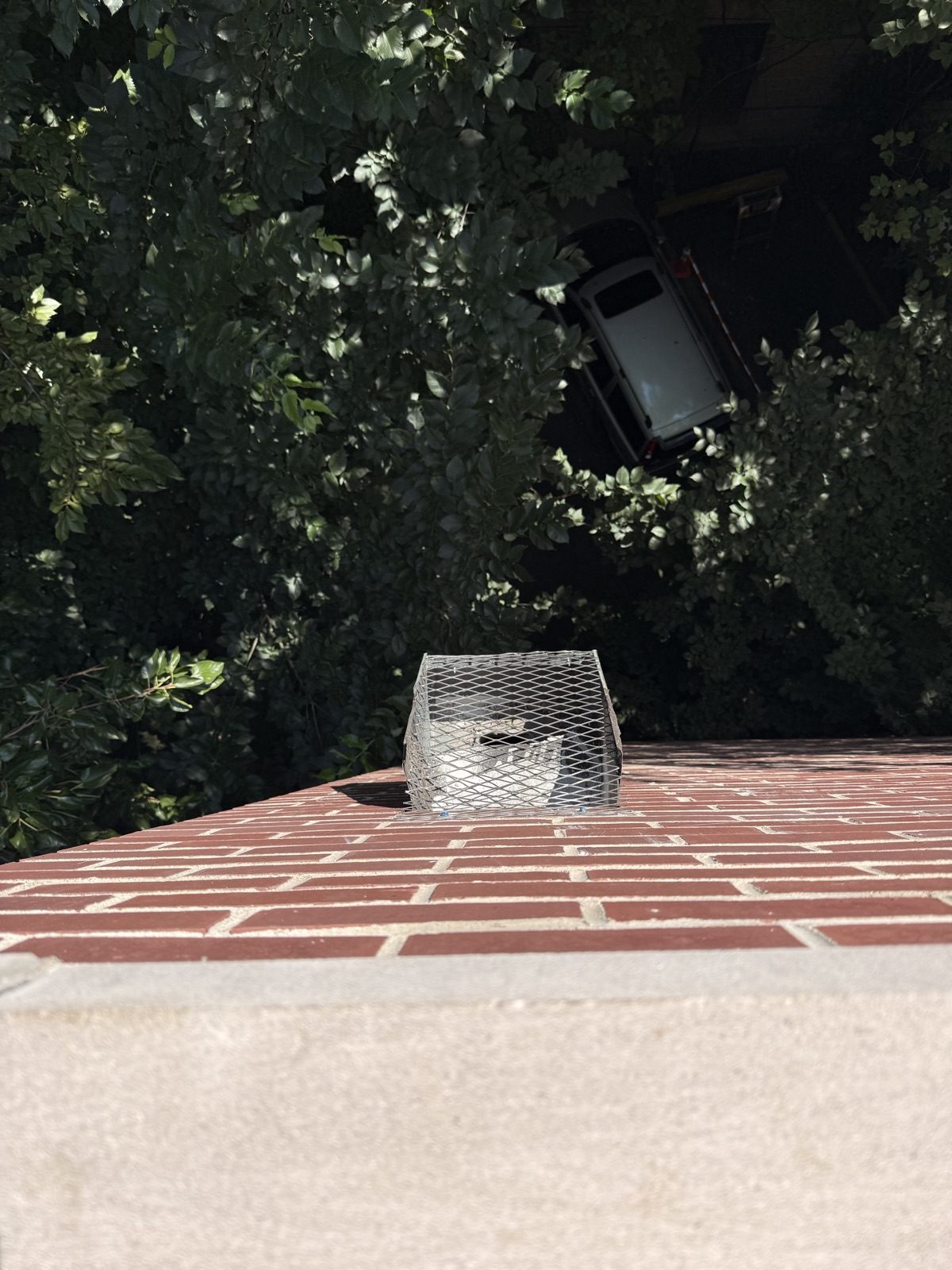
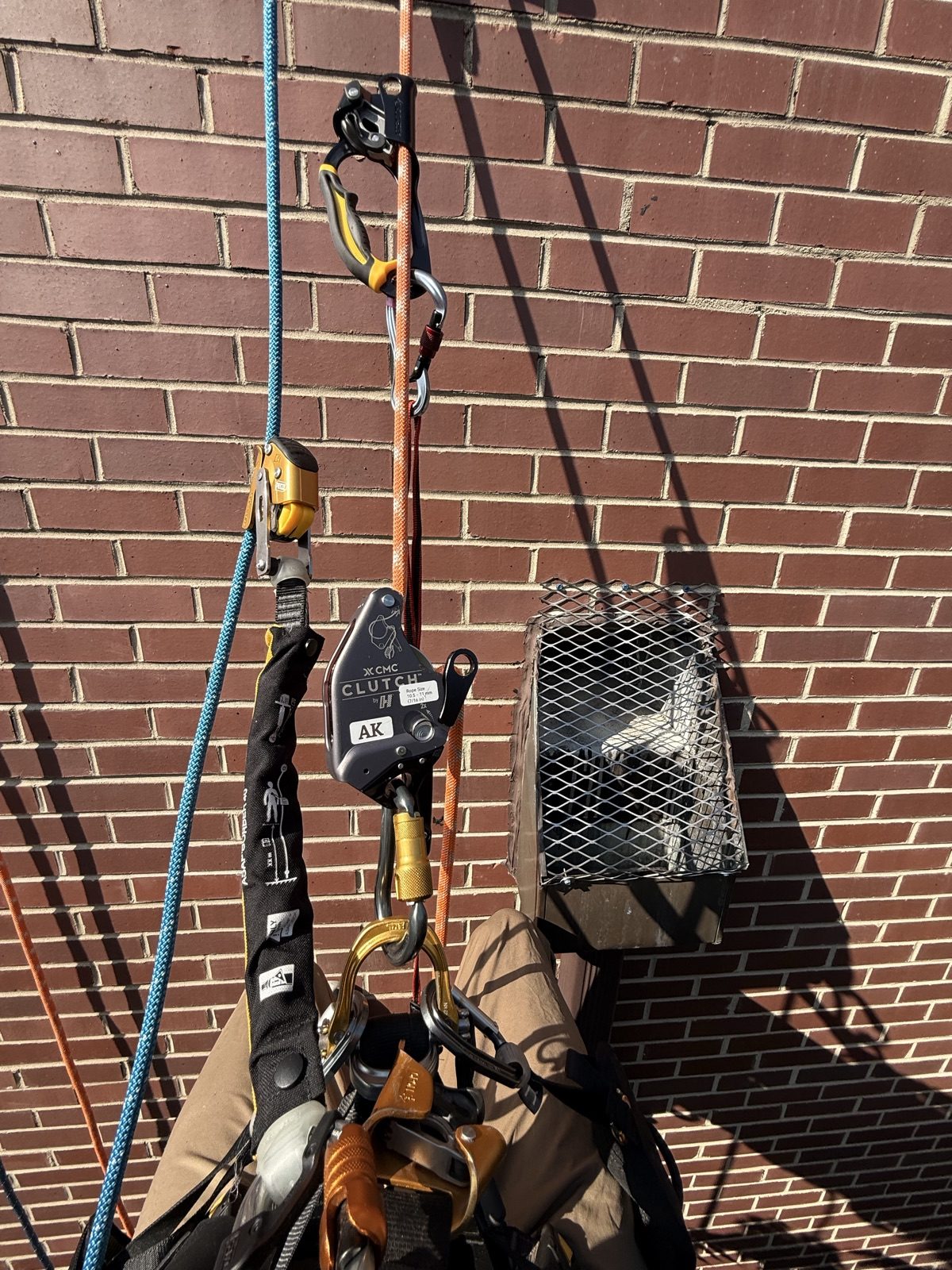
Every opening on the building was photographed from the rope, before and after.
Each screen is expanded stainless steel mesh, formed into a five-sided hood and fitted over the mouth of the conductor head. Stainless because it sits in standing water and Chicago road salt for decades and cannot be the part that fails; expanded mesh because it is rigid enough to hold its shape without a frame and open enough not to restrict flow.
The usual worry is that a screen will turn into a clog. It doesn't, as long as it is sized right. The hood is fabricated larger than the opening it covers, which means the total open area of the mesh is several times the cross-section of the downspout throat below it. Water never sees the mesh as a restriction — the pipe is the bottleneck, not the screen. What the mesh stops is anything too big to pass through it: birds, nesting material, and the leaf litter that used to wash straight into the pipe.
Fastening matters as much as the mesh. Screws through the flange into the metal head and the mortar joints mean the screen cannot be lifted by wind, and a bird working at the edge finds nothing that gives. Gutters and downspouts run exactly as before. The birds have moved on.
Two numbers drive the price of any bird-proofing job at height: the covers themselves, and getting a person to them.
| Item | Typical |
|---|---|
| Stainless screen, per cover Fabricated to the opening, fitted and fastened | $200–$300 |
| Rope access setup Rigging and rappelling, one location on the building | $800–$1,000 |
The setup charge is the part people don't expect, and it's the one that should shape how you plan the work. Rigging is the same effort whether the technician installs one screen or eight, so a single opening carries the entire access cost by itself, while a whole building splits it across every opening. If ropes have to be moved to a different elevation to reach the far side of the building, expect an additional charge for the second rig.
The practical takeaway: if birds are in one downspout, they will be in the others by next spring. Screening the whole building on one descent is usually the cheaper decision, not the more expensive one — and it is the only version of this job that doesn't need doing again.
Figures are typical ranges for planning, not a quote. Height, the number of elevations, and roof anchoring all move the number.
Budget roughly $200 to $300 per cover for a fabricated stainless steel screen, fitted and fastened. On top of that, a job at height carries a rope-access setup charge, typically $800 to $1,000, covering rigging and rappelling at one location on the building. Because setup is the largest single line, screening every opening on one visit costs far less per opening than coming back for them one at a time.
Not when they are sized correctly. The screen is fabricated larger than the opening it covers, so the total open area of the mesh is greater than the throat of the downspout below it. Water passes at full flow; the screen only stops what is too big to fit through the mesh.
An open conductor head is a sheltered box with high walls, a solid floor and a roof overhead — close to the rock-ledge cavity a rock pigeon nests in naturally. Upper floors are also the least disturbed part of a building, so nests go unnoticed until the downspout stops draining or the noise reaches the top-floor unit.
Yes. Rope access anchors at the roof and works down the face of the building, so it needs a roof and an anchor point rather than setup room on the ground. On Chicago lots where the gangway is too narrow for a lift and the alley has no staging room, it is often the only practical way to reach an upper-floor opening.
Rope is protected at every edge contact and rigging is padded where it bears on the building. Anchor points and the descent path are chosen before anyone goes over the edge, and the before-and-after photos double as a condition record for the owner or the association.
If you have birds in a downspout, a gutter or a vent above ladder height — in Old Town, the Near North Side, or anywhere on the North Side and the North Shore — these are the contractors we recommend.
Chimney, fireplace, masonry, and dryer vent work — serving Chicago's North Shore since 2017, with masons and inspectors on staff and more than 1,100 Google reviews. Inspections are documented diagnostic appointments: video, photos, and written findings. chimneymonkey.com
Call Chimney Monkey: 847-994-4388Exterior cleaning and maintenance — window cleaning, gutter cleaning, roof soft washing, and solar panel cleaning — serving Palatine and Chicago's North Shore. panepal.us
Call Pane Pal: 224-458-2496